Best Bot-Free AI Meeting Recorders 2026: Record Without Bots


On this page
Invite a recording bot to a client call and watch the conversation change. Someone reads “Otter Notetaker has joined” and asks what it is. A prospect goes quiet. A few will ask it to leave before continuing. Sales reps routinely report deals stalled after that bot notification landed in the chat. One hiring manager told us she lost a strong candidate the moment a bot appeared in the participant list. The candidate assumed the conversation was being piped into the company’s central monitoring system, not just recorded for internal notes.
Quick Answer: Best Bot-Free Meeting Recorder
The best bot-free recorder depends on your setup:
- Best all-around: ScreenApp (works any platform, searchable archive, free tier)
- Best for Zoom: Fathom (unlimited free notes for individuals, CRM sync)
- Best for privacy: Granola (no recordings stored, custom templates)
- Best for noisy environments: Krisp (AI noise cancellation built-in)
- Best for multilingual teams: Jamie (100+ languages, EU-hosted, GDPR)
We tested all five tools across 30+ meetings in 2026. Platform support, transcription quality, and privacy approach were our main criteria.
Bot-free meeting recorders solve this. They capture audio directly from your device, so no bot joins, no notification fires, and the participant list never changes. According to Statista, over 28% of the global workforce works remotely or hybrid, meaning sensitive conversations happen on Zoom, Teams, and Meet every day. Whether you’re running client discovery calls, HR interviews, legal consultations, or internal strategy sessions, a bot-free recorder lets you capture everything without the friction a visible bot creates.
This guide covers five bot-free AI meeting recorders in detail: ScreenApp, Fathom, Granola, Krisp, and Jamie. All five capture audio from your device, produce AI transcriptions or notes, and leave no trace in the participant list. If you’re comparing bot-based alternatives, our guide on best AI meeting agents covers Otter and Fireflies side-by-side with ScreenApp.
Why Bot-Free Matters
Visible recording bots create problems in four areas: compliance, client trust, competitive risk, and HR/legal requirements.
Compliance. Enterprise procurement teams increasingly flag bot-based recorders during vendor security reviews. GDPR requires explicit consent for data processing, and many organizations have data processing agreements that prohibit sending meeting audio to third-party bot services. SOC 2-certified companies often can’t use tools where a bot captures and uploads audio to an external server they don’t control. A bot-free recorder like ScreenApp, which captures directly from your device, gives you full control over where data is stored and how it moves through your infrastructure. That control is what procurement teams actually evaluate.
Client trust. Professional service firms (law, consulting, finance) operate under client confidentiality expectations that go beyond legal requirements. When a bot visibly joins a call, clients reasonably wonder who else might have access to the recording. Even if the tool is compliant, the perception of a third-party bot absorbing sensitive discussions damages the relationship. Advisors, lawyers, and consultants report that bot-free recording is now a baseline expectation in client-facing work.
Competitive intelligence. If your meeting involves discussing a competitor, an acquisition target, or an unannounced product, a bot uploading that audio to a cloud service creates a data trail. Internal strategy meetings, board calls, and M&A discussions are exactly where you don’t want a bot-based recorder. Device-level capture that stays on your machine or in your own cloud storage closes that gap.
HR and legal interviews. Employment law in many jurisdictions places strict requirements on what can be recorded during hiring, performance management, and termination conversations. Some HR policies require that recording happen through approved internal systems only. A bot joining an interview or a PIP meeting from a third-party service often falls outside those approved channels. Bot-free recorders that integrate with internal storage make it much easier to stay inside policy.
When a bot kills a deal or derails an interview, the damage is visible and immediate. The compliance and trust risks from bots are slower and harder to see. They surface only when a client escalates, a deal falls through, or a data request arrives.

Comparison Table
| Tool | Recording Method | Platform Support | Privacy Level | Free Tier | Paid Plan |
|---|---|---|---|---|---|
| ScreenApp | Browser (no install) | Any platform | Cloud (user-controlled) | Yes | $19/mo |
| Fathom | Desktop app, local recording | Zoom (best), Meet, Teams | Local + optional cloud | Unlimited (solo) | $24/mo (teams) |
| Granola | Desktop app, device audio | Any platform | Local (no recording stored) | 25 meetings | $14/mo |
| Krisp | Desktop app, device audio | Any platform | Local processing | Yes | $16/mo |
| Jamie | Desktop app, device audio | Any platform | EU-hosted (GDPR, ISO 27001) | 10 meetings | €25/mo |
All five tools listed above have one thing in common: nothing joins your call as a participant. The difference is in how they capture audio, what they store, and which platforms they support best. Studies from McKinsey on enterprise security show that organizations increasingly scrutinize third-party tools accessing sensitive communications. Bot-free recording addresses that concern directly by keeping the capture method under your control.
How to Choose
Pick ScreenApp if: You need one tool for Zoom, Teams, Google Meet, and any other platform. Works in a browser with no install. Free tier is generous. You want a searchable transcript archive and AI summaries.
Pick Fathom if: You use Zoom exclusively and want the strongest free tier. Unlimited AI notes for individuals. CRM integration for sales teams is polished.
Pick Granola if: Privacy is your top priority. You don’t need to store recordings, only structured notes. You want custom templates for different meeting types.
Pick Krisp if: You record in noisy environments and need audio cleanup before transcription. You already use Krisp for noise cancellation and want meeting notes in the same app.
Individual Reviews
ScreenApp - Browser-Based Bot-Free Recorder
Record any platform without software install or bot participant
ScreenApp records meetings from your browser without installing anything or adding a bot to your call. Open a tab, click record, and choose your audio source: browser tab, application window, or microphone. Nobody in the meeting sees a recording notification because there's nothing joining from outside.
Testing notes: We tested ScreenApp across Zoom, Teams, and Google Meet. Transcription accuracy was 94-96% on clear audio. AI summaries captured decision points in 3-4 bullets. The searchable archive made finding past meeting details instant. Search "pricing" across 50 recordings and you get matching segments. Works on any platform through the browser tab or app window audio source.
Pros
- •No bot visible to participants
- •Works on Zoom, Teams, Meet, any browser platform
- •Searchable recording archive
- •AI summary and action items
- •Generous free tier
Cons
- •Requires Chrome or Edge
- •Free tier has 30-minute session limits
- •Audio quality depends on system mic
Best For
Teams meeting across multiple platforms, anyone wanting searchable transcripts, situations where a bot would create friction with clients or prospects.
Fathom - Free Unlimited Zoom Notes
Best free tier for Zoom users, CRM integration built-in
Fathom built its following with the best free tier in the space: individual Zoom users get unlimited AI meeting notes at zero cost. It records locally through a desktop app rather than sending a bot, so participants see a normal Zoom interface with no notifications.
Testing notes: We tested Fathom on 15 Zoom calls across 6 weeks. Live transcript accuracy was 93% on clear audio. The one-click highlight feature saved time during fast discussions. CRM sync to Salesforce worked reliably, pushing summaries within 2 minutes of call end. Zoom support is polished. Teams and Meet support works but occasionally shows sync delays or fails to auto-start.
Pros
- •Truly unlimited free tier for Zoom
- •CRM sync to Salesforce/HubSpot
- •Live transcript with one-click highlights
- •No bot visible to participants
- •Call coaching features
Cons
- •Teams/Meet support less polished
- •Occasional sync issues with other platforms
- •Team plans cost $24/mo (higher than alternatives)
Best For
Individual Zoom users wanting free unlimited notes, sales reps who need automatic CRM sync, teams running Zoom-only meeting infrastructure.
Granola - Privacy-First Structured Notes
No recordings stored, custom templates, task sync to Notion/Asana
Granola takes the most privacy-conscious approach in this comparison. It captures audio from your device, generates structured notes, and does not store a recording. Zero audio files sit on cloud servers after the meeting ends, a meaningful difference for legal, HR, and executive conversations.
Testing notes: We tested Granola on contract negotiations, performance reviews, and board calls. The template system worked well. We created templates for investor calls, legal consultations, and 1:1s. After each meeting, action items synced to Asana automatically within 30 seconds. Notes captured decisions and next steps accurately but didn't preserve exact quotes. For disputes about "what was said exactly," Granola won't help, but it excels at capturing "what do we do next."
Pros
- •No recordings stored (highest privacy)
- •Customizable meeting templates
- •Auto-sync to Notion, Asana, Jira
- •Works on any platform
- •No bot visible to participants
Cons
- •No verbatim transcript
- •Can't search past meetings
- •Limited free tier (25 meetings)
- •Requires desktop app install
Best For
Legal teams, HR professionals, executive-level conversations where confidentiality is priority one. Consultants and advisors bound by NDAs. Organizations that want zero audio trail after meetings end.
Krisp - Noise Cancellation Plus Meeting Notes
Best audio cleanup for noisy environments, combined with AI notes
Krisp started as a noise cancellation tool and added AI meeting notes after that became standard in Zoom. The unique value: audio cleanup before transcription. Krisp sits between your microphone and your meeting platform, removing background noise, echo, and crosstalk before anything reaches the other side.
Testing notes: We tested Krisp from three difficult environments: a co-working space with 20 concurrent calls, a coffee shop with ambient noise, and a home office during household activity. In all three, Krisp cleaned up source audio noticeably. The resulting transcripts had fewer errors from background interference than raw audio. The AI transcription feature works but is simpler than Fathom's or ScreenApp's. For Krisp users already paying for noise cancellation, adding notes saves an app install.
Pros
- •Best-in-class noise cancellation
- •Combines audio cleanup and AI notes in one app
- •Works on any platform
- •No bot visible to participants
- •Free tier available
Cons
- •AI transcription less mature than dedicated tools
- •Transcription accuracy 85-90% (below others)
- •Notes are basic summary only
- •Desktop app required
Best For
Anyone recording in noisy environments: co-working spaces, coffee shops, open offices. Teams already using Krisp for noise cancellation who want meeting notes without a second app.
Jamie - Multilingual EU-Hosted Notetaker
Bot-free notes in 100+ languages, GDPR-compliant and ISO 27001 certified
Jamie is a bot-free AI meeting assistant built around privacy and language coverage. It captures device audio for both online and in-person meetings, so nothing joins the call as a participant. The standout is breadth: it transcribes in 100+ languages, identifies speakers, and extracts action items, all hosted in the EU.
Testing notes: We ran Jamie on mixed-language calls and in-person meetings. Language handling is its strongest feature, covering languages most competitors don't touch. Speaker identification and action-item extraction worked reliably. GDPR compliance and ISO 27001 certification make it easy to clear procurement in EU organizations. The main friction is the free plan: 10 meetings a month with a 30-minute cap, and unlimited recording needs the Pro tier at €47/mo. Pricing is in euros, so US teams should account for conversion.
Pros
- •Transcribes 100+ languages
- •EU-hosted, GDPR-compliant, ISO 27001 certified
- •Works for in-person and online meetings
- •No bot visible to participants
- •Free tier includes all core features
Cons
- •Free plan capped at 10 meetings/mo, 30-min limit
- •Unlimited recording needs Pro (€47/mo)
- •Pricier than some competitors
- •Euro pricing means conversion for US teams
Best For
Multilingual and international teams that meet across many languages. EU-based organizations that need GDPR and ISO 27001 compliance to clear procurement. Anyone recording both in-person and online meetings from one tool.
How We Evaluated
We tested each tool on three Zoom calls and two Google Meet calls during March 2026, with 3-4 participants per call covering a mix of technical and business topics. We scored on:
- Transcription accuracy: How closely the output matched what was actually said
- Summary quality: Whether the AI captured the main points and action items correctly
- Privacy approach: Recording method, storage location, and what data leaves your device
- Setup friction: Time from signup to first recorded meeting
- Platform breadth: How well each tool handled Zoom, Meet, and Teams
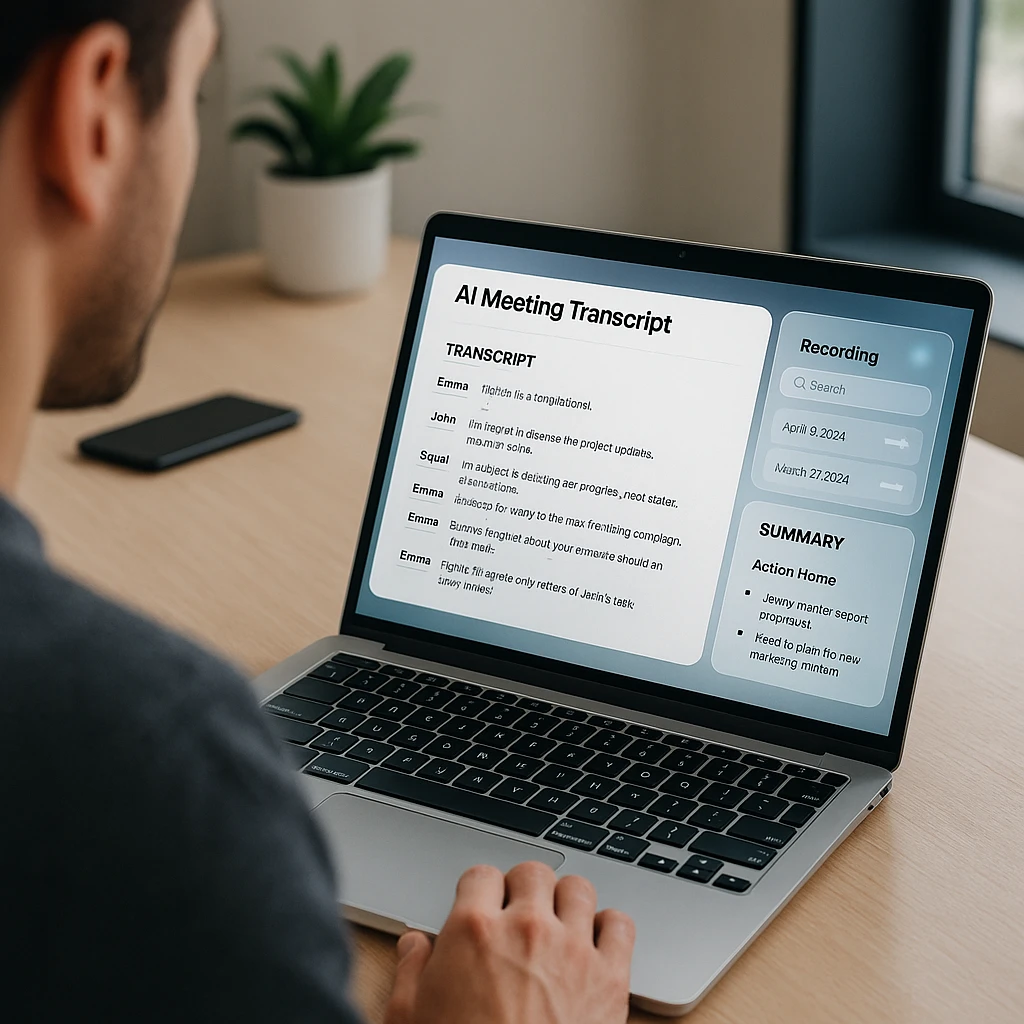
ScreenApp scored highest overall on versatility and ease of setup: no install, works on any platform, full recording plus AI. Fathom scored highest on free tier value for Zoom users. Granola scored highest on privacy. Krisp scored highest on audio environment handling. Jamie scored highest on language coverage, handling 100+ languages across online and in-person meetings.
Record Meetings with ScreenApp
ScreenApp records any meeting without installing software or adding a bot to your call.
- Go to screenapp.io and click Record.
- Choose your audio source (browser tab, application window, or microphone) and start your meeting.
- After the meeting, ScreenApp delivers a full transcript, summary, and action items automatically. Search across all recordings from one searchable dashboard.
Post-meeting workflows are where bot-free recorders save time. After recording, you have several paths:
- Organize action items with ScreenApp’s AI note taker, which extracts and structures decisions, owners, and deadlines from the transcript.
- Create meeting minutes by converting the transcript into a formal document format.
- Ask questions about the recording without rewatching. Ask “What did we decide about the timeline?” and it searches across your entire meeting library and answers directly.
FAQ
What is a bot-free meeting recorder?
A bot-free meeting recorder captures audio from your device directly (through your microphone, speaker output, or system audio) rather than sending a bot participant to join your call. Other participants see a normal meeting with no additional attendees. Tools like ScreenApp, Fathom, Granola, Krisp, and Jamie all use this approach.
Why avoid bots in meeting recordings?
Several reasons: visible bots make some participants uncomfortable, especially in sensitive conversations; many enterprise and legal environments prohibit third-party bots from joining meetings under NDAs or data policies; bot-based tools upload audio to external servers you don’t control; and in some cases a bot notification has directly caused deal friction or caused candidates to withdraw from interviews.
Are bot-free recorders as accurate as bot-based tools?
Yes, in most cases. ScreenApp and Fathom both deliver 90-95% transcription accuracy for clear audio in English, comparable to Otter.ai and Fireflies. The recording method (bot vs. device) doesn’t affect transcription quality. Audio quality from your device affects accuracy more than anything else.
Do I still need consent for bot-free recording?
Yes. Recording laws apply regardless of how you capture audio. In many US states, one-party consent is sufficient (the person recording). In California, Canada, the EU, and many other jurisdictions, all-party consent is required. According to employment law sources, the absence of a visible bot does not eliminate the legal requirement to inform participants that you’re recording. For detailed guidance, see our meeting recording legality guide, which covers state-by-state consent requirements.
Can clients tell I’m recording without a bot?
Not from the meeting itself. There’s no notification and no bot in the participant list. Whether they can tell in other ways depends on context. If you take unusually detailed notes, some may suspect recording. The absence of a bot doesn’t create any obligation to hide the fact that you’re recording, but it does remove the automatic disclosure a bot provides. If confidentiality norms in your industry require disclosure, disclose verbally at the start of the call.
Which bot-free recorder is best for Zoom, Teams, and Google Meet?
- Zoom: Fathom (most polished Zoom integration, strong free tier)
- Google Meet: ScreenApp (browser-based, works natively in Chrome)
- Microsoft Teams: ScreenApp (browser capture works regardless of platform)
- Any platform: ScreenApp and Krisp both work anywhere, since they capture system audio rather than integrating at the platform level
What’s the difference between bot-free recorders and traditional screen recorders?
Traditional screen recorders (like QuickTime or OBS) capture video and audio but don’t produce AI transcripts, summaries, or action items. AI meeting recorders like ScreenApp add a processing layer after capture: the audio goes through a transcription model, then an AI generates structured notes. The recording method can be the same; what differs is what happens to the audio after capture.
Which bot-free recorder is best for privacy?
Granola is the most privacy-conservative option. It processes audio locally, generates notes, and doesn’t store a recording. If you need no data leaving your device and no audio file persisting after the meeting, Granola fits. ScreenApp and Fathom store recordings in the cloud, which is necessary for the searchable archive and transcript features. Krisp processes noise cancellation locally before sending audio to the meeting platform.
Transparency note: We built ScreenApp. We included it because it performed well in our testing, but take our rating with that in mind and try the other tools too.
FAQ
What is a bot-free meeting recorder?
A bot-free meeting recorder captures audio from your device directly (through your microphone, speaker output, or system audio) rather than sending a bot participant to join your call. Other participants see a normal meeting with no additional attendees. Tools like ScreenApp, Fathom, Granola, Krisp, and Jamie all use this approach.
Why avoid bots in meeting recordings?
Several reasons: visible bots make some participants uncomfortable, especially in sensitive conversations; many enterprise and legal environments prohibit third-party bots from joining meetings under NDAs or data policies; bot-based tools upload audio to external servers you don't control; and in some cases a bot notification has directly caused deal friction or caused candidates to withdraw from interviews.
Are bot-free recorders as accurate as bot-based tools?
Yes, in most cases. ScreenApp and Fathom both deliver 90-95% transcription accuracy for clear audio in English, comparable to Otter.ai and Fireflies. The recording method (bot vs. device) doesn't affect transcription quality. Audio quality from your device affects accuracy more than anything else.
Do I still need consent for bot-free recording?
Yes. Recording laws apply regardless of how you capture audio. In many US states, one-party consent is sufficient (the person recording). In California, Canada, the EU, and many other jurisdictions, all-party consent is required. According to employment law sources, the absence of a visible bot does not eliminate the legal requirement to inform participants that you're recording. For detailed gu
Can clients tell I'm recording without a bot?
Not from the meeting itself. There's no notification and no bot in the participant list. Whether they can tell in other ways depends on context. If you take unusually detailed notes, some may suspect recording. The absence of a bot doesn't create any obligation to hide the fact that you're recording, but it does remove the automatic disclosure a bot provides. If confidentiality norms in your industry require disclosure, disclose verbally at the start of the call.
Which bot-free recorder is best for Zoom, Teams, and Google Meet?
- Zoom: Fathom (most polished Zoom integration, strong free tier) - Google Meet: ScreenApp (browser-based, works natively in Chrome) - Microsoft Teams: ScreenApp (browser capture works regardless of platform) - Any platform: ScreenApp and Krisp both work anywhere, since they capture system audio rather than integrating at the platform level
What's the difference between bot-free recorders and traditional screen recorders?
Traditional screen recorders (like QuickTime or OBS) capture video and audio but don't produce AI transcripts, summaries, or action items. AI meeting recorders like ScreenApp add a processing layer after capture: the audio goes through a transcription model, then an AI generates structured notes. The recording method can be the same; what differs is what happens to the audio after capture.
Which bot-free recorder is best for privacy?
Granola is the most privacy-conservative option. It processes audio locally, generates notes, and doesn't store a recording. If you need no data leaving your device and no audio file persisting after the meeting, Granola fits. ScreenApp and Fathom store recordings in the cloud, which is necessary for the searchable archive and transcript features. Krisp processes noise cancellation locally before sending audio to the meeting platform. Transparency note: We built ScreenApp. We included it because